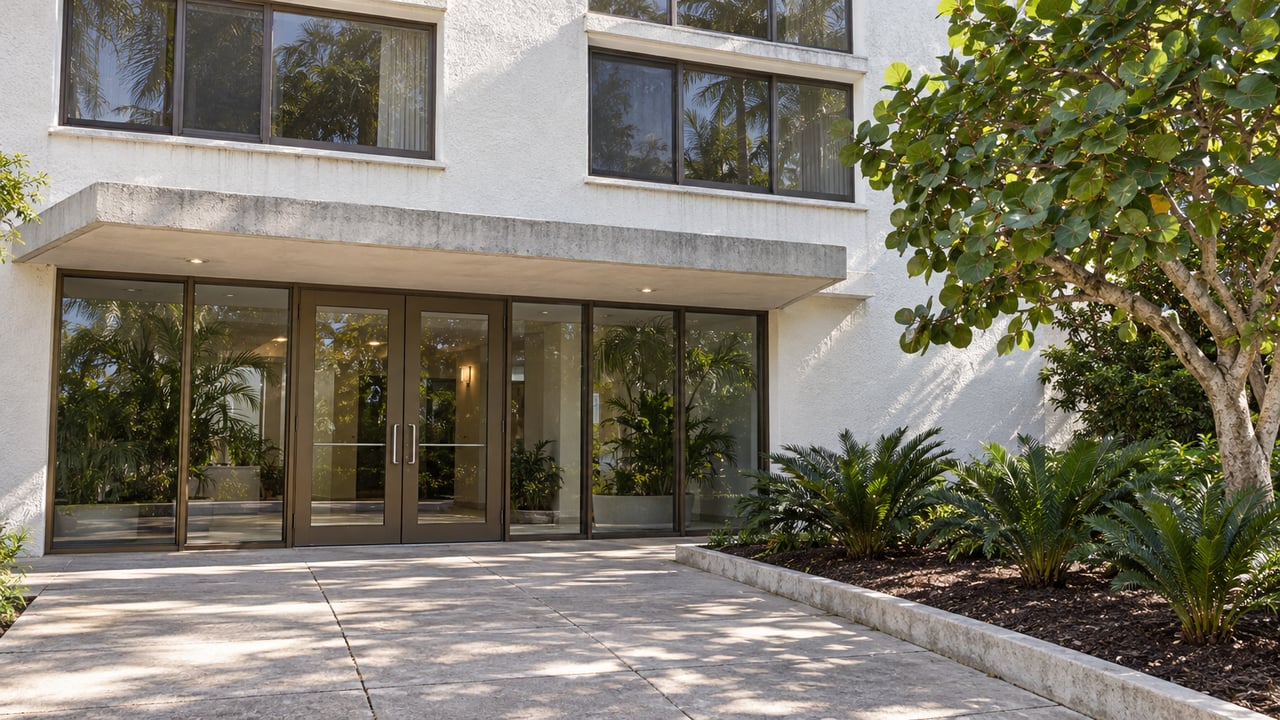
In August 2026, the median sale price for a Broward County condo rose 3.96% from a year earlier, to $257,500. In the same month, condo closings fell 9.3% to 883. Existing condos carried 9.9 months of supply, which MIAMI REALTORS® + RWorld classifies as a buyer's market.
Prices usually don't climb in a buyer's market. These did because of which condos sold that month. Starting this summer, the condo association's finances also go a long way toward deciding who can buy a given unit at all.
What changed for mortgage buyers on August 3
On loan applications dated on or after August 3, 2026, Fannie Mae retired its Limited Review process for established condo projects. Those buildings now go through Full Review or, if they qualify, a Waiver of Project Review. Freddie Mac retired its Streamlined Review on the same date. Both agencies announced the changes on March 18, 2026, in Fannie Mae's Lender Letter LL-2026-03 and Freddie Mac's Bulletin 2026-C.
The reserve requirements matter most for older buildings. When a lender uses a reserve study to show a building has enough reserves, it must now confirm that the association's budget includes the highest recommended reserve allocation from that study. Lenders can no longer rely on the "baseline" funding method, which lets a reserve balance get close to zero.
In practice, a buyer applying for a conventional mortgage is applying on behalf of the building too. The Real Deal's August 9 analysis put it this way: the association's financial health now has a bigger effect on whether a deal closes, at least when a mortgage is involved. It also noted that lenders are asking for insurance coverage and maintenance history.
The same rule opens some buildings and closes others
Two credible sources describe this change in ways that sound opposite. Both are correct.
Congressman Byron Donalds' March 19, 2026 release calls the change a win for Florida. It says Florida condo borrowers had faced a 25% down payment under Limited Review, and that conventional terms with 3% to 5% down will now be available. Fannie Mae's letter backs up the geographic part: the change "effectively retires the remaining geographic restrictions that apply to the state of Florida."
Robert Smith, a regional president at FirstService Residential, told The Real Deal that buildings still working on reserve funding or large capital projects will be harder to finance. His examples were roofs, concrete restoration, hurricane windows and elevator modernization. He added that associations that have been proactive will benefit, and that the benefit could show up in prices. The Real Deal's August 5 report noted that the deeper review could slow loan processing and kill some deals.
So the rule works in both directions. A building with fully funded reserves and current records can now offer buyers the same low-down-payment terms available in other states. A building that is behind on reserves sees fewer buyers able to get conventional financing. "Broward condo" no longer describes a single market. It covers buildings lenders will finance and buildings where buyers are mostly limited to cash.
Cash buyers already account for half the market
The cash-only scenario was already common before August. In August 2026, 461 of Broward's 883 condo and townhouse sales closed in cash. That is 52.2%, nearly the same as the 52.0% share in August 2025.
Government-backed loans are an even smaller factor. According to MIAMI REALTORS®, citing HUD statistics, only 21 of the 2,397 condo buildings in Miami-Dade, Broward and Palm Beach counties are approved for FHA loans. That is 0.9%.
Rates make borrowing harder still. Freddie Mac's 30-year fixed rate averaged 6.67% in August 2026 and had risen to 7.17% by September 15. Gay Cororaton, chief economist at MIAMI REALTORS® + RWorld, said she expects "more cash and high-end buyers to drive the South Florida real estate market."
For a seller, this means a large share of potential buyers depends on whether lenders will approve the building. If they won't, the buyer pool shrinks to cash buyers, who can usually negotiate harder.
Where Broward's sales dropped and where they grew
The price-band data shows how a weaker market can still post a higher median. MIAMI REALTORS® publishes Broward price tiers for townhouses and condos combined, so the bands below include both.
| Sale price, August 2026 | Closed sales | Change vs. August 2025 |
|---|---|---|
| Under $200,000 | 323 | -12.2% |
| $200,000 to $299,999 | 174 | -18.7% |
| $300,000 to $399,999 | 141 | -9.0% |
| $400,000 to $499,999 | 106 | -1.9% |
| $500,000 to $599,999 | 38 | -20.8% |
| $600,000 to $699,999 | 24 | +9.1% |
| $700,000 to $799,999 | 20 | +17.6% |
| $800,000 to $899,999 | 12 | +71.4% |
| $900,000 to $999,999 | 11 | +120.0% |
| $1 million or more | 34 | +13.3% |
Every band under $600,000 had fewer sales than a year earlier, and every band from $600,000 up had more. Those lower bands still made up 782 of the 883 sales. When fewer low-priced units close and more high-priced units close, the median rises even if no individual unit gained value. This is a mix effect, and a 4% rise in the median doesn't mean a typical condo is worth 4% more.
The Real Deal saw the same split across the wider region. Its October 7 report said the luxury market has kept outperforming lower price points. It added that more affordable housing stock often needs repairs or renovations, "making it less affordable in reality." The same report said the older segment of the condo market has been one of Florida's largest sources of inventory since 2021.
Countywide, inventory has been falling. Broward had 9,427 condo listings at the end of August 2026, down 14.84% from 11,070 a year earlier. Supply can drop while sales at lower prices drop faster. That's how months of supply stays at 9.9 in a lower-inventory market.
Many older Broward buildings fall under the state law
The lender rules apply on top of Florida's post-Surfside condo safety law. Data from HOA Contact Lists, cited by The Real Deal, counts 780 Broward buildings under the 2022 law. The Real Deal notes the data is unofficial because municipalities track compliance differently. The law requires milestone structural inspections for condo and co-op buildings of three or more stories at 30 years of age, or at 25 years for buildings closer to the coast, and every ten years after that.
A state report released this summer found that 8,736 buildings had completed phase-one inspections and 1,575 had completed phase two. Nearly 1,600 deadline extensions were granted, and 94% of them went to buildings in coastal municipalities, mostly in Miami-Dade, Broward and Palm Beach counties.
The state rules and the lender rules measure the same thing, which is whether an association is funding its reserves. Under section 718.112 of the Florida Statutes, budgets adopted on or after December 31, 2024 must fully fund reserves for items covered by the structural integrity reserve study, or SIRS. Qualifying associations controlled by unit owners may pause or reduce those contributions for up to two consecutive budgets through December 31, 2028. That requires a recent milestone inspection, a majority vote of owners, and meeting other conditions.
A pause can be legal under state law and still matter at loan time. A building whose budget doesn't include the highest recommended reserve allocation can run into the lender standard described above.
Upcoming dates
- December 31, 2026: Qualifying associations may complete their SIRS alongside a milestone inspection due by this date, but the statute says the SIRS may not be completed after it.
- January 4, 2027: For Full Review loan applications dated on or after this date, Fannie Mae's minimum reserve allocation rises from 10% to 15% of the annual budgeted assessment income. Freddie Mac uses the same date.
- December 31, 2028: The window closes for qualifying associations to pause or reduce reserve contributions.
The January date matters for anyone buying with a mortgage this winter. A building that meets the 10% minimum today could fall short of 15% on applications dated after the holiday season. The 2026 legislative session didn't change the core rules. Florida Realtors reports that the HOA and condominium reform bill, HB 657, did not pass. According to the same report, the budget carried forward $27 million for the My Safe Florida Condominium program.
Questions to ask about a building
Since August 3, the building's documents can affect a financed purchase as much as the unit's condition does. Smith summarized it to The Real Deal: buyers "now need to evaluate the financial health of the condominium association just as carefully as they evaluate the home itself." Useful questions include:
- Has the association completed its SIRS, and does the current budget include the highest recommended reserve allocation from that study?
- Has the building completed its milestone inspection, and did it reach phase two?
- Has the association voted to pause or reduce reserve contributions, and for which budget years?
- Are there special assessments approved or under discussion for roofs, concrete restoration, windows or elevators?
- Does the budget meet a 15% reserve allocation ahead of January 4, 2027?
- Have recent buyers in the building closed with conventional financing, or mostly with cash?
How lenders and inspectors treat the answers depends on each building. The questions explain why two similar units a few blocks apart can draw very different buyer pools.
FAQ
Does Broward's higher median mean condo values went up across the board? Not necessarily. In August 2026, sales fell in every band below $600,000 and rose in every band above it. Most of the median's increase comes from that change in the mix of units sold.
Are FHA loans an option for most Broward condos? Only 21 of 2,397 condo buildings in the three-county region are FHA-approved, according to HUD figures cited by MIAMI REALTORS®.
Did the August change make condo loans easier or harder? It depends on the building. Florida's geographic restrictions ended, and Donalds' office says borrowers in qualifying buildings can now get 3% to 5% down terms. Buildings that don't meet the reserve standards face more scrutiny.
Can an association still pause reserve contributions? Qualifying owner-controlled associations can do so for up to two consecutive budgets through December 31, 2028, if they meet the statute's conditions. A lender reviewing the building's budget will apply its own reserve standard separately.
When you're looking at a Broward condo, The 90th Group can help you collect the association's reserve study, inspection status and budget before you make an offer, so that you and your lender are evaluating the same building. If you're selling, we can help you prepare those same documents for the buyers who will ask for them. Contact Us to talk through a specific building with our team.
This article is general information, not legal, tax or financial advice. Consult a qualified professional about your situation.